
For decades, fragrance has occupied a unique position in the beauty industry.
It is often the element consumers remember most about a product, yet it is also one of the most complex parts of a formulation. A single fragrance can contain dozens or even hundreds of individual substances, many of which occur naturally in essential oils, botanical extracts and plant-derived ingredients.
That complexity has long presented a challenge for regulators.
Fragrance allergens remain one of the leading causes of cosmetic contact allergies, prompting ongoing debate about how much information consumers need to make informed purchasing decisions. While the EU has required certain fragrance allergens to be disclosed on cosmetic labels since the mid-2000s, scientists and regulators have spent the last decade examining whether those requirements still reflect what is known about fragrance-related allergies today.
The result is one of the most significant fragrance labeling updates the cosmetics industry has seen in years.
Why regulators decided the original list was no longer enough
The EU’s fragrance allergen requirements have evolved over time, reflecting ongoing scientific review and growing interest in consumer transparency.
For years, dermatologists, researchers and regulators have been examining the role fragrance ingredients play in allergic skin reactions. Fragrance remains one of the most common causes of cosmetic contact allergy, prompting growing calls for greater transparency and better consumer information.
This led the Scientific Committee on Consumer Safety (SCCS), the European Commission’s independent scientific advisory body, to conduct a comprehensive review of fragrance allergens and consumer exposure. Their review examined sensitisation rates, dermatological data, exposure levels and evidence from allergy monitoring networks across Europe.
The conclusion was clear: the original list of 26 allergens no longer reflected the full range of fragrance substances capable of triggering allergic reactions in sensitised consumers.
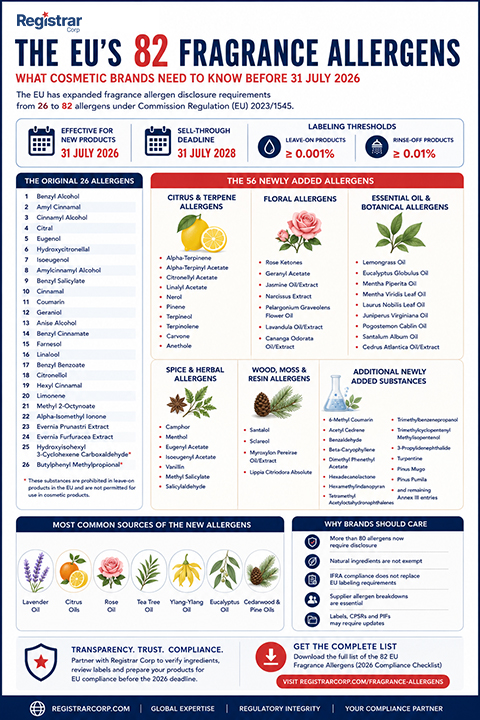
As a result, the European Commission adopted Commission Regulation (EU) 2023/1545, expanding fragrance allergen disclosure requirements from 26 allergens to more than 80 substances and substance groups requiring individual consideration on cosmetic labels.
That increase alone highlights the scale of the change facing the industry.
For nearly two decades, cosmetic brands have built formulations, labeling processes and compliance programs around the original list of 26 fragrance allergens. The new requirements introduce more than 56 additional allergens, many of which occur naturally in essential oils, botanical extracts and fragrance mixtures commonly used throughout the beauty industry.
In practical terms, this means products that have been sold in the EU for years without requiring significant allergen review may now warrant a closer look. For some brands, the impact may be limited. For others, particularly those with large portfolios or extensive use of botanical ingredients, the number of affected products could be far greater than anticipated.
From a consumer perspective, the objective is straightforward. Consumers who know they are sensitive to specific fragrance ingredients should have access to clearer information when choosing products.
From a business perspective, however, achieving that transparency is not always straightforward.
Which products are most likely to be affected?
When many people hear the term “fragrance allergen”, they immediately think of perfume. The reality is much broade
r. Fragrance ingredients appear across almost every category of beauty and personal care products, from facial moisturisers and cleansers to shampoos, conditioners, body lotions, sunscreens and hand creams.
In fact, some of the products most likely to require careful review may be those marketed as natural, botanical or clean beauty products. Ingredients such as lavender oil, citrus oils, rose oil, eucalyptus oil, tea tree oil and ylang-ylang oil are naturally complex mixtures containing multiple fragrance compounds. Several of those compounds now fall within the scope of the expanded allergen requirements.
This creates an interesting challenge for brands. Consumer demand for natural ingredients has never been stronger. Yet from a regulatory perspective, natural ingredients are often more complex to assess than individual synthetic ingredients because they contain numerous naturally occurring constituents.
A lavender essential oil is not a single substance. A citrus extract is not a single substance. Each may contain multiple allergens that need to be identified, assessed and potentially disclosed.
For brands that have built their positioning around botanical ingredients, the amount of work required may come as an unwelcome surprise.
Why ingredient transparency is becoming more important
One of the biggest misconceptions surrounding the new requirements is that the information needed for compliance is already sitting somewhere in a company’s files. In reality, many brands are discovering that obtaining complete visibility into fragrance allergens can be more challenging than expected.
The reason is simple. Most cosmetic companies do not manufacture fragrance ingredients themselves. Instead, they rely on allergen declarations provided by fragrance houses, flavor suppliers and essential oil manufacturers. As companies begin evaluating products against the expanded requirements, ensuring that these declarations are up to date and readily accessible is becoming increasingly important.
Some documentation may be current. Some may not. Some may provide the level of detail needed. Some may not.
This is particularly challenging for products that have been on the market for years. A formulation that met every requirement when it launched may now require a fresh review simply because the regulatory landscape has changed.
For companies managing extensive product portfolios, this can quickly evolve into a substantial data-gathering execise.
Why an IFRA certificate may not answer every question
Another area creating confusion is the relationship between IFRA compliance and EU allergen disclosure requirements. Many brands understandably assume that if a fragrance complies with IFRA standards, their compliance obligations have largely been addressed.
Unfortunately, the two serve different purposes. IFRA standards are designed to promote the safe use of fragrance ingredients. EU allergen requirements are designed to provide consumers with transparency about ingredients that may trigger allergic reactions. A fragrance can satisfy IFRA requirements while still requiring allergen declarations under EU legislation. This distinction is prompting many regulatory teams to revisit fragrance documentation and supplier data that may not have been reviewed in detail for years.
The cost of discovering issues late
Most brands understand that updating a label carries a cost. What is often underestimated is the chain of decisions that follows.
A label change may seem minor, but it rarely stays confined to the label itself.
- Ingredient declarations are updated
- Artwork requires revision
- Packaging specifications change
- Approval cycles begin again
- Production schedules are adjusted
- Launch timelines come under pressure
Viewed individually, each step may seem manageable. Across a large product portfolio, however, the cumulative impact can be significant.
The stakes become even higher when products are already moving through the supply chain. Regulatory authorities have the power to take action against non-compliant products, including recalls, market withdrawals and sales restrictions. Beyond the direct financial implications, these actions can create reputational challenges that are far more difficult to quantify.
For beauty brands, the real challenge is rarely the label update itself. It is understanding the full scope of work required before those changes begin affecting timelines, resources and commercial plans.
Why this matters beyond the EU
Although much of the industry’s attention is focused on the EU deadline, the broader trend is impossible to ignore.
The United Kingdom has already adopted requirements that mirror the EU’s approach to fragrance allergen labeling, meaning brands selling in both markets may need to consider compliance on both sides of the Channel.
Beyond Europe, Canada has announced plans to align with the EU’s expanded fragrance allergen approach, while California has introduced fragrance ingredient reporting requirements under its Fragrance and Flavor Ingredient Right-to-Know Act. Other markets are also evaluating measures aimed at increasing ingredient transparency.
| European Union | United Kingdom | Canada |
California |
| Expanded fragrance allergen disclosure requirements | Aligned with EU fragrance allergen requirements | Aligning with EU approach | Fragrance reporting requirements |
| Effective July 2026 | Expected to mirror EU implementation | Emerging requirements | Already driving transparency |
| Sets the benchmark | Maintains regulatory alignment | Following the trend | Supporting consumer visibility |
This means fragrance transparency is unlikely to remain an EU-only conversation.
For global brands, the work being done today to understand formulations, ingredient data and labeling requirements may help prepare for future requirements elsewhere. In that sense, the 31 July 2026 deadline is more than a compliance milestone. It may offer a glimpse of where cosmetic regulation is heading next.
What brands should be doing now
The companies in the strongest position today are not necessarily those that have completed every review. They are the companies that have started asking the right questions.
- Which products contain fragrances, essential oils or botanical extracts?
- Do suppliers provide detailed allergen information?
- Are existing records up to date?
- Which products are most likely to require label changes?
- Where are the biggest gaps?
Many organisations are prioritising high-volume products and leave-on formulations first, while simultaneously requesting updated allergen information from suppliers and reviewing supporting documentation.
The goal is not simply to meet a deadline. The goal is to avoid surprises. Because the companies most likely to struggle with the transition are not necessarily those with the most complex formulations. They are the companies that underestimate the amount of work required until it is too late.
Beyond the deadline
The EU’s expanded fragrance allergen requirements represent far more than an update to ingredient declarations. They reflect a broader shift toward greater ingredient transparency and consumer awareness, one that is already influencing regulatory discussions beyond Europe.
For cosmetic brands, the challenge is not simply preparing for 31 July 2026, when the new requirements become mandatory for products placed on the EU market. It is understanding how those requirements affect existing formulations, supplier relationships, documentation processes and product development strategies.
Some companies may discover that only a handful of products require attention. Others may find that the impact extends across a much larger portion of their portfolio than anticipated.
What is clear is that the brands best positioned for the transition will be those that begin asking questions early, long before labels need updating and packaging decisions have been finalised.
Because while the deadline may still seem some distance away, understanding where fragrance allergens exist within a product portfolio can take considerably longer than many companies expect.
For an industry built on innovation, transparency is increasingly becoming just as important as formulation. The organisations that invest in that visibility today will be better prepared not only for the EU’s fragrance allergen requirements, but for the next generation of cosmetic regulations that may follow.
Need help evaluating your products?
Registrar Corp helps cosmetic brands review ingredient documentation, assess labeling requirements and identify potential compliance gaps for the EU and UK markets.

